An Appreciation: Frank Gehry’s New World Center «Answer to Miami»
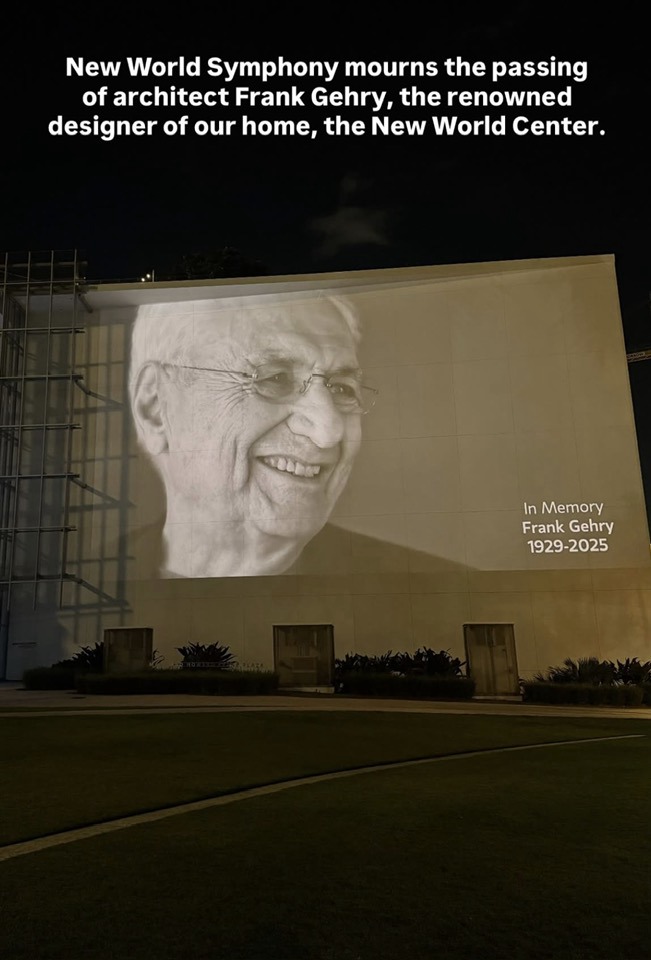
FRANK GEHRY (1929-2025)
Some buildings answer questions their cities have not yet fully learned how to ask. The New World Center is one of them. When Frank Gehry completed his long-awaited debut in Florida, he didn’t simply add a concert hall to Miami’s skyline—he gave the city a cultural conscience made of glass, light, and sound.
Conceived in close partnership with conductor and visionary Michael Tilson Thomas, the New World Center is not merely an architectural object, but a living instrument. From the beginning, this was never meant to be a monument to ego. It was designed as a tool for music, for education, and for the future—an idea as rare as it is necessary in a city often defined by speed, spectacle, and surface.
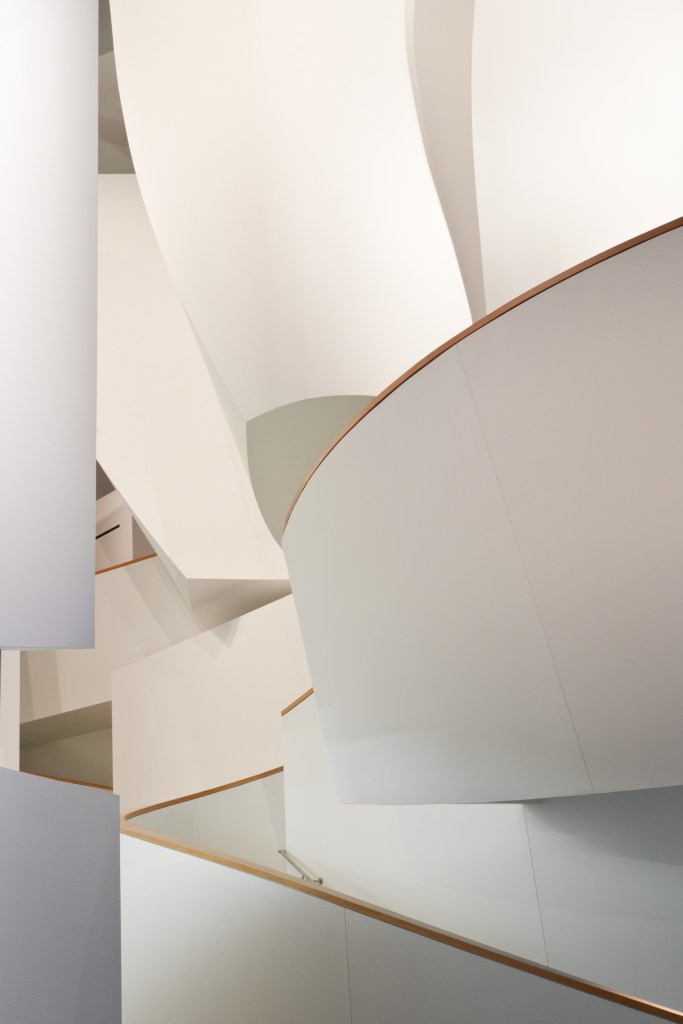
Gehry’s restraint here is as striking as any of his celebrated gestures elsewhere. Instead of explosive curves dominating the skyline, Miami received a luminous white cube—calm, almost modest—yet alive with inner movement, a sort of inviting «Lotus Flower» plenty of meanings. Behind its transparent skin, the building unfolds like a secret: rehearsal rooms, floating staircases, hidden chambers, and at its heart a 757-seat theater where the boundary between performer and listener dissolves.
Inside, sound reigns. The acoustics are not simply good—they are revelatory. Musicians speak of clarity, presence, and intimacy. Listeners experience something rarer still: nearness. This is not a hall that overwhelms; it invites. It listens back.
Gehry and MTT conceived the building as a living, interactive organism, reflected in the interplay between public and private, exterior and interior. The street sees the orchestra at work, and the orchestra sees the street. A double glass wall creates an oasis within this city-within-a-city devoted to cultivating talent.

Suspended in the foyer, a metal sculpture by Frank Stella converses with white walls as sinuous as the classic Gehry bar stools. The vast terrace-garden serves as a second lobby with equidistant views of the ocean and Biscayne Bay. Framed by a park-auditorium, concerts are broadcast onto a giant screen dominating the northeast party wall. A parking structure—sine qua non for the American public—connects to the lobby via an elevated bridge.
It is a wager against the uniformity imposed by the proliferation of condominium towers, one that reanimates an identity forged in the Art Deco era and demanded by its privileged natural surroundings. A model of collaboration between two visionaries, the New World Center encapsulates Miami’s artistic past, present, and future.
The partnership between Gehry and Tilson Thomas is the invisible architecture holding everything together. One shaped space; the other shaped time. Together they created not a trophy, but a promise: that Miami could be more than a backdrop—that it could be a center.
Years after its inauguration, the New World Center continues to prove that architecture, when guided by musical intelligence and civic purpose, can do something extraordinary. It can give a city not just a venue, but a voice.
And Miami, at last, has one that sings.
FRANK GEHRY (1929-2025)
Una Apreciación: El New World Center de Frank Gehry, “Mi respuesta a Miami”
Algunos edificios responden preguntas que sus ciudades aún no han aprendido del todo a formular. El New World Center es uno de ellos. Cuando Frank Gehry completó su largamente esperado debut en Florida, no se limitó a añadir una sala de conciertos al perfil de Miami: le otorgó a la ciudad una conciencia cultural hecha de vidrio, luz y sonido.
Concebido en estrecha colaboración con el director y visionario Michael Tilson Thomas, el New World Center no es simplemente un objeto arquitectónico, sino un instrumento vivo. Desde el inicio, nunca estuvo destinado a ser un monumento al ego. Fue diseñado como una herramienta para la música, para la educación y para el futuro: una idea tan excepcional como necesaria en una ciudad a menudo definida por la velocidad, el espectáculo y la superficie.
La contención de Gehry aquí resulta tan impactante como cualquiera de sus celebrados gestos en otros proyectos. En lugar de curvas explosivas dominando el horizonte, Miami recibió un cubo blanco y luminoso —calmo, casi modesto—, pero vibrante en su movimiento interior, una suerte de «flor de loto» acogedora. Detrás de su piel transparente, el edificio se despliega como un secreto: salas de ensayo, escaleras flotantes, cámaras ocultas y, en su corazón, un teatro de 757 localidades donde la frontera entre intérprete y oyente se disuelve.
En su interior, reina el sonido. La acústica es reveladora. Los músicos hablan de claridad, presencia e intimidad. Los oyentes experimentan algo aún más raro: la cercanía. No es una sala que abruma; invita.
Suspendida en el foyer, una escultura metálica de Frank Stella dialoga con paredes blancas tan sinuosas como los clásicos taburetes de Gehry. La vasta terraza-jardín funciona como un segundo lobby con vistas equidistantes del océano y de la bahía de Biscayne. Enmarcados por un parque-auditorio, los conciertos se proyectan en una pantalla gigante que domina el muro noreste. Un estacionamiento —sine qua non para el público estadounidense— se conecta al vestíbulo mediante un puente elevado.
Se trata de una apuesta contra la uniformidad impuesta por la proliferación de torres de condominios, una que reactiva una identidad forjada en la era Art Déco y exigida por su privilegiado entorno natural. Modelo de colaboración entre dos visionarios, el New World Center encapsula el pasado, el presente y el futuro artístico de Miami.
La sociedad entre Gehry y Tilson Thomas es la arquitectura invisible que lo sostiene todo. Uno modeló el espacio; el otro, el tiempo. Juntos no crearon un trofeo, sino una promesa: que Miami podía ser algo más que un telón de fondo, que podía ser un verdadero centro.
Años después de su inauguración, el New World Center sigue demostrando que la arquitectura, cuando está guiada por la inteligencia musical y el propósito cívico, puede hacer algo extraordinario. Puede darle a una ciudad no solo un recinto, sino una voz.
Y asi Miami, por fin, tiene una.
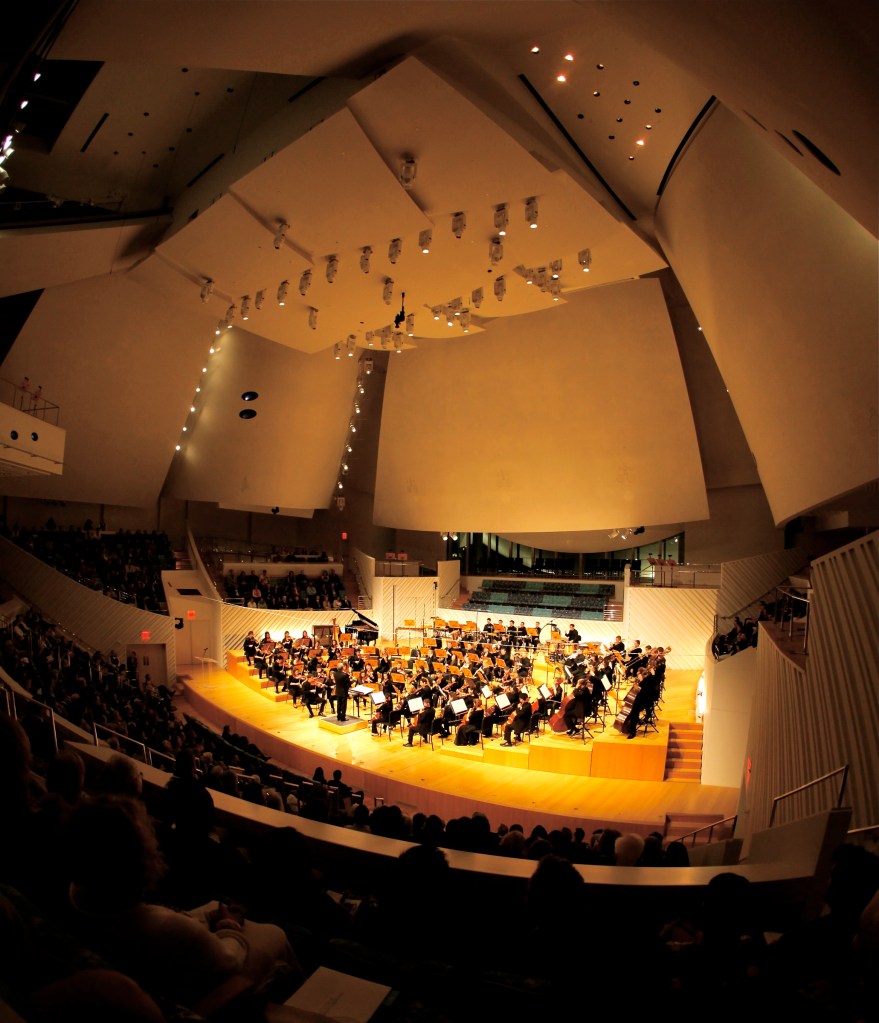
New World Symphony en el New World Center – foto: Tomas Loewy
