Zimmermann-Perianes, A Conjunction of Pure Music
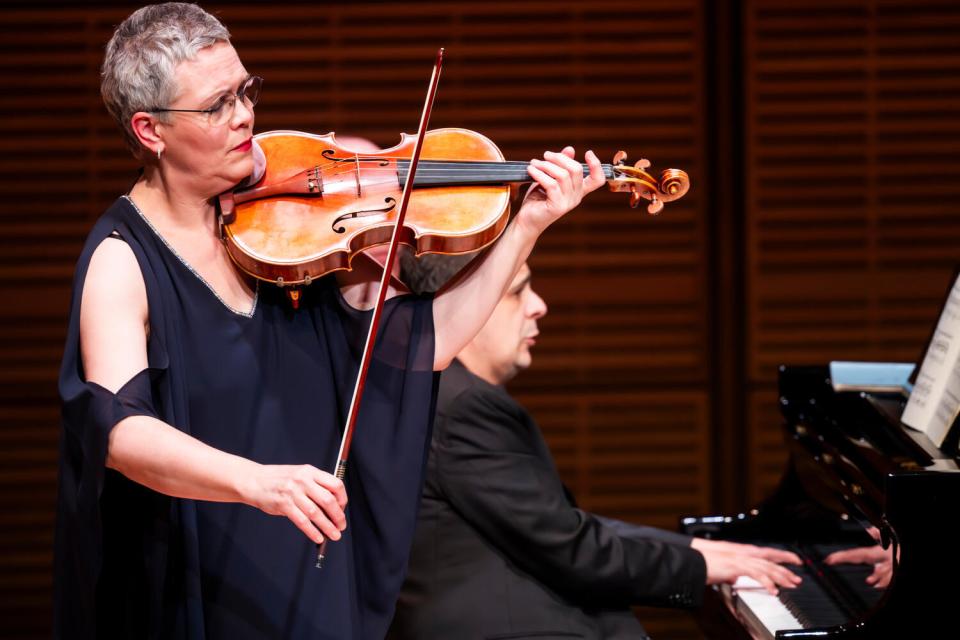
They do not form a duo in the strict sense of the term; however, each time they meet on stage—a circumstance that fortunately occurs with notable frequency—the German violist Tabea Zimmermann and the Spanish pianist Javier Perianes reveal a rapport that recalls the most enduring chamber partnerships. The nature of their understanding—a kind of aesthetic combustion between Central European and Mediterranean traditions—transcends mere collaboration to enter the realm of an organic, almost instinctive artistic affinity. As part of their American tour, they offered at Carnegie Hall a recital of exceptional caliber before a full house, in which Perianes, with refined stylistic awareness, assumed his role as an Andalusian Knight, enhancing the virtues of the First Lady of the viola. Both displayed highly refined expressivity and a shared approach to pure music, elevating one another, with Perianes not in any sense subordinate but rather an articulator of the joint discourse, ennobling with aristocratic discretion the instrumental voice of Zimmermann, an indispensable figure of the contemporary viola.
The program opened with the Fantasiestücke, Op. 73 by Robert Schumann, pieces originally conceived for clarinet and piano, here revisited in the viola transcription by Zimmermann herself together with Hartmut Höll. This version not only preserves the lyrical substance of the original but reconfigures it timbrally, allowing the viola to deploy an expressive spectrum of particular density and warmth. The performance was distinguished by a nearly vocal breadth of phrasing—a remarkably homogeneous cantabile legato—supported by a piano of transparent diction and exquisite dynamic control. The result was the evocation of a true instrumental Liederabend, in which the alternation of character between the pieces found organic continuity in the shared breathing of the two performers.
The transition to late Romanticism unfolded naturally with the Second Sonata for viola and piano by Johannes Brahms, likewise derived from its original version for clarinet. In this work, marked by an unmistakable autumnal tone and introspective emotional density, Zimmermann and Perianes constructed a discourse of great structural cohesion, in which the dialectic between both parts—the grave, reflective cantabile of the viola against the piano’s discursive impulse—resolved into a synthesis of remarkable balance. The shaping of climaxes, carefully graded, avoided any temptation toward rhetorical excess, instead favoring a restrained expressivity deeply rooted in Brahmsian tradition. The interaction between the musicians, of almost conversational naturalness, allowed the work to be perceived as a space of shared confidence, in which each motif seemed to arise from a common memory. Indeed, watching them interact, “converse in music,” turned the audience into literal eavesdroppers on a meeting of two friends sharing experiences and secrets.
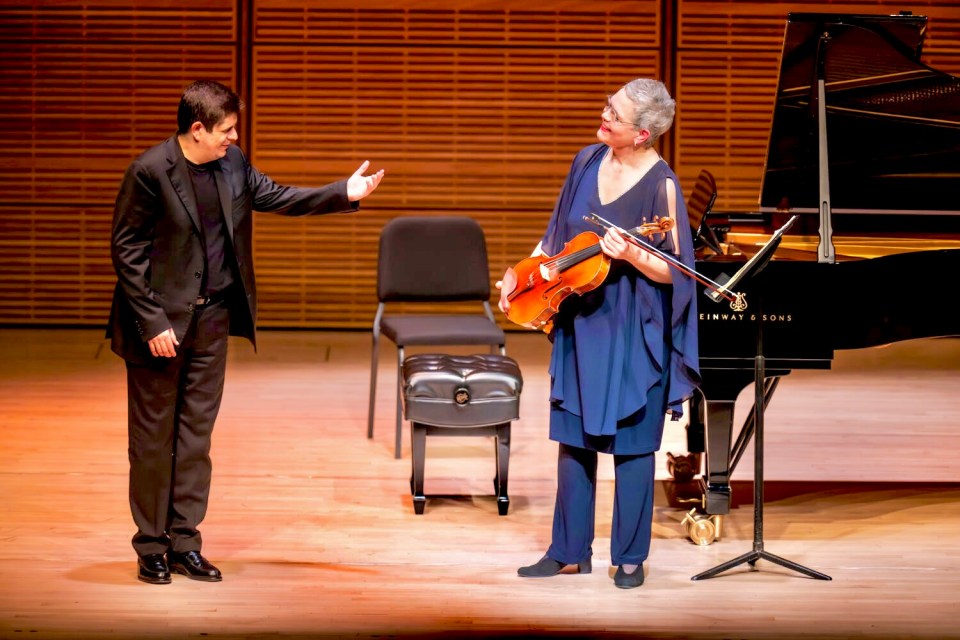
A point of aesthetic inflection came with Lachrymae by Benjamin Britten, a singular work within the viola repertoire, constructed as a series of retrospective variations on the song “If my complaints could passions move” by John Dowland. Here, timbre assumed decisive prominence: Zimmermann explored, with almost experimental rigor, an extreme palette of colors, from veiled sonorities to deliberately raw emissions, while Perianes outlined a harmonic space of suspended resonances at the threshold of audibility. The gradual revelation of Dowland’s theme—more suggested than stated—became the axis of a reading that oscillated between fragmentary memory and veiled allusion, shaping an experience of undeniable symbolic density. Between light and shadow, the music seemed suspended by a thread, approached by Zimmermann and Perianes with exemplary rigor, a dry yet reverberant lyricism, serving as a bridge as significant as it was immaculate toward the final offering of the evening by a composer so intimately linked to Britten.
The expressive core of the recital was reached with the Sonata for viola and piano by Dmitri Shostakovich, the composer’s last completed work, written in the imminence of death. In this score, of extraordinary economy of means and conceptual depth, the performers succeeded in articulating a dramatic arc of notable internal coherence. The first movement, restrained and austere, was presented with a latent tension that avoided any superficial emphasis; the second, with its characteristic sarcasm, assumed an almost grotesque dimension without losing structural clarity. It was, however, in the final Adagio that the interpretation reached its apex: the celebrated allusion to Beethoven’s “Moonlight” Sonata emerged as one more layer within a texture of superimposed transparencies, in which time itself seemed to dilate toward dissolution. Zimmermann sustained the line with a searing intensity of sound, while the piano contributed to the sensation of a musical fabric disintegrating. The result was a reading of existential depth, in which the music faded not as an ending but as a passage toward a space of metaphysical resonance—a kind of Liebestod with music itself, wherein the spirit of Beethoven abides, immovable and eternal.
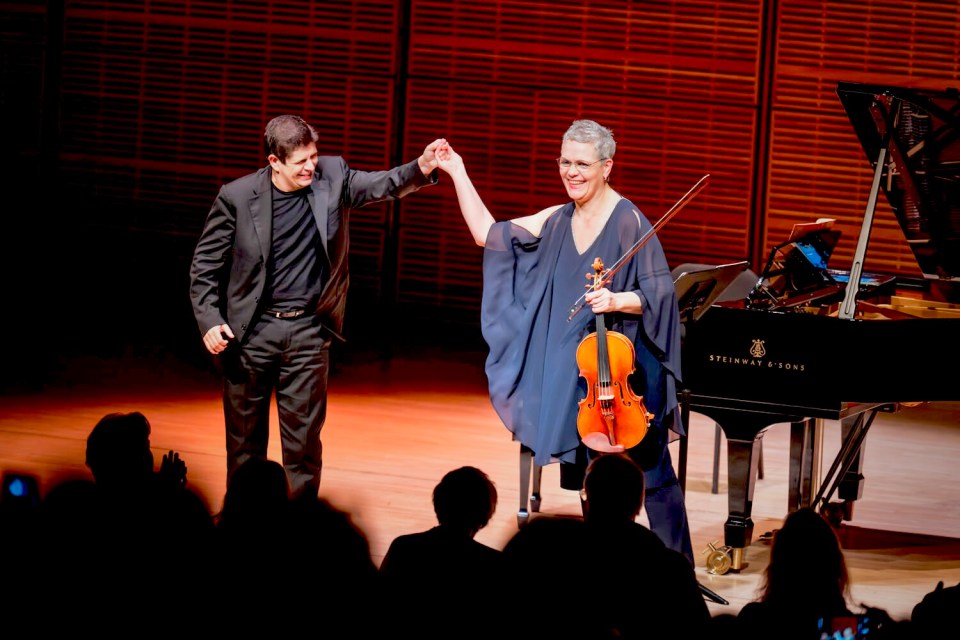
The prolonged standing ovation led to an intimate encore: the Andante from the Three Romances by Clara Schumann, offered as the epilogue to an evening of exceptional aesthetic coherence. In its apparent simplicity, this piece allowed the performers to distill one final instance of purified lyricism, closing the program with a sense of inwardness that confirmed the singularity of an artistic encounter of rare magnitude.
PHOTOS CHRIS LEE, COURTESY CARNEGIE HALL
