Two Evenings, Two Worlds: Requiem & Die Fledermaus
Last weekend, Miami witnessed two musical offerings that laid bare the contrast between entertainment and artistic depth. Both, of course, can — and should — coexist within the cultural ecosystem of any healthy metropolis. Yet, as the perceptive Marschallin observes in Richard Strauss’s Der Rosenkavalier, “it is in the how that all the difference resides.”
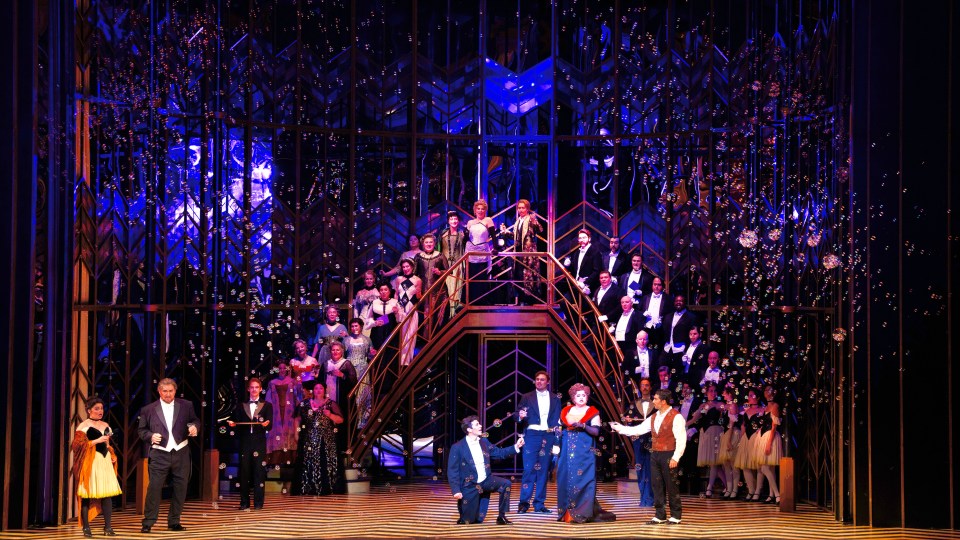
Florida Grand Opera opted for visual sparkle with Die Fledermaus, Johann Strauss Jr.’s immortal operetta, landing somewhere between decorative appeal and true theatrical effectiveness. Despite undeniable visual impact, this Bat never quite took flight.
The production, originally conceived by Stephen Lawless for the Glyndebourne Festival in 2003 and later incorporated into the Washington National Opera’s repertory, relocates the action to the Jugendstil — Vienna’s Art Nouveau — as a symbolic transition toward the decadent modernity of the early twentieth century. Benoît Dugardyn’s beautiful revolving set, conceived as a succession of mirrored panels with geometric motifs inspired by champagne labels and direct resonances of Gustav Klimt’s ornamental universe, evokes Hollywood musicals and even suggests an allegorical vision of a world dancing on the deck of the Titanic.
Musically, Die Fledermaus still bubbles with vitality; igniting its theatrical spark, however, has become increasingly difficult. Its comedy has aged: beyond its considerable length, much of the humor today feels outdated, at times awkward, and occasionally simply puerile, as does the worn-out structure of entanglements, hidden identities, and lighthearted revenge that once functioned as social satire. Attempts to modernize it through local references proved equally futile.
Designed for a smaller theater, the production’s scenic structure tended to dissolve within the vastness of the Arsht Center. The first two acts maintained visual coherence, but the final act foundered in a non-sense prison setting dominated by a revolving stage used to exhaustion.
Compounding matters was the unfortunate cancellation of the two announced stars, Joyce El-Khoury and Nathan Gunn — a circumstance not disclosed to the audience on opening night. They were replaced by Esther Tonea and Alex Granito, both of whom performed capably. The chorus and remaining cast showed an even level, led by Rebecca Nielsen’s idiomatic Adele — modest in voice but secure — along with tenors John Viscardi and Ricardo García. The most stylistically grounded presence was the veteran Louis Otey, while the gifted Ginger Costa-Jackson was simply miscast as Orlovsky — always a tricky role — whose parlando passages were delivered through relentless shouting to the point of exasperation.
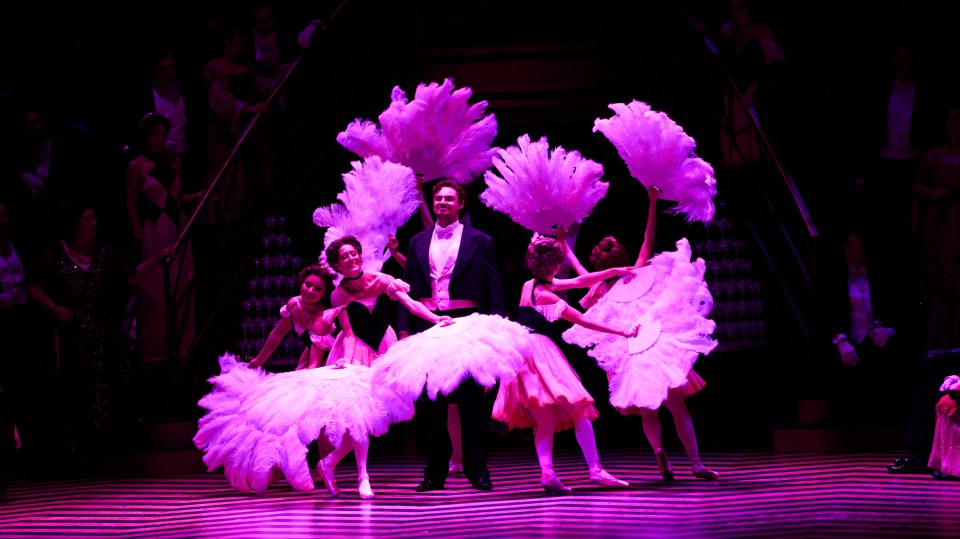
Under the baton of its new music director, the Spaniard Pablo Mielgo, FGO’s recently formed orchestra performed competently, though sounding somewhat opaque and revealing occasional coordination issues between pit and stage on opening night. Time will undoubtedly bring the necessary cohesion to this new endeavor. The second-act dances proved effective, thanks to the ever-reliable Rosa Mercedes.
In the end, the evening’s promotional slogan — “Dress to impress” — seemed to inadvertently capture the spirit of the night: dazzling on the surface, but still searching for the essence that might justify it.
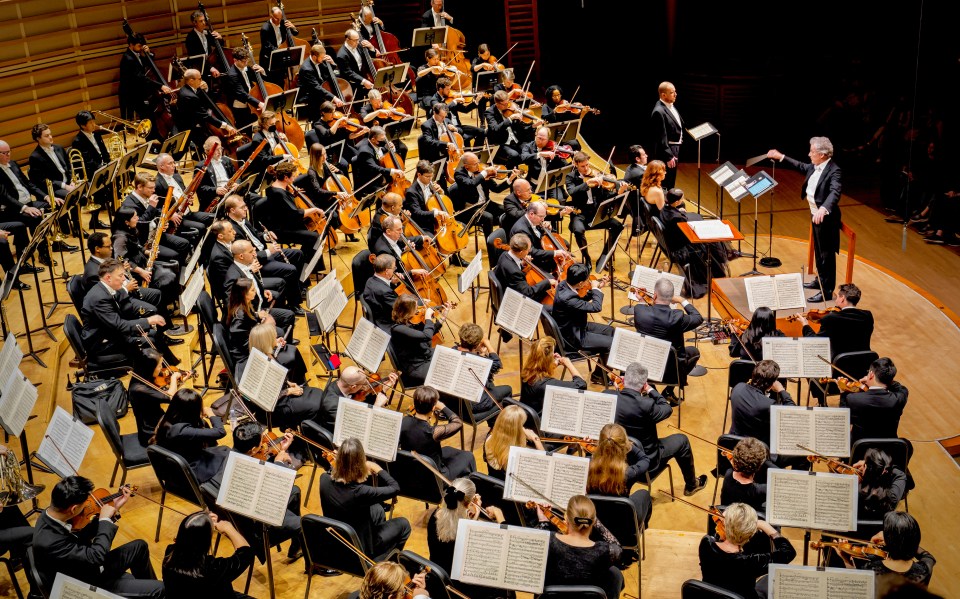
A different story—quite literally—unfolded across the way in the Knight Hall with the long-awaited arrival of Verdi’s Requiem. The monumental work took two decades to reach the Arsht Center stage, but the wait proved worthwhile, delivering a performance of the caliber every major musical city aspires to.
From the outset, it was a privilege to hear the Cleveland Orchestra, whose sonic polish and impact were beyond dispute. From the iridescent strings that prelude Verdi’s vast fresco to the apocalyptic brass of the Tuba mirum, each intervention traced a kind of Sistine Chapel Last Judgment in sound. The effect was impressive.
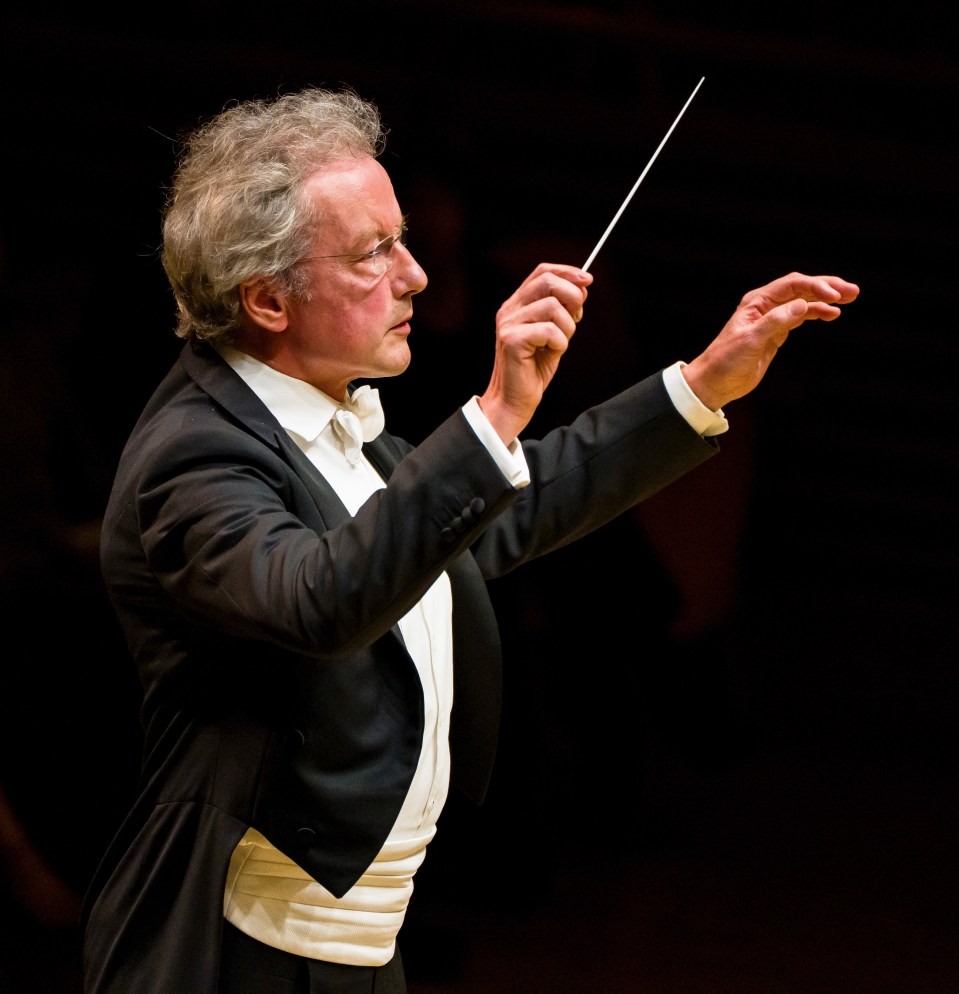
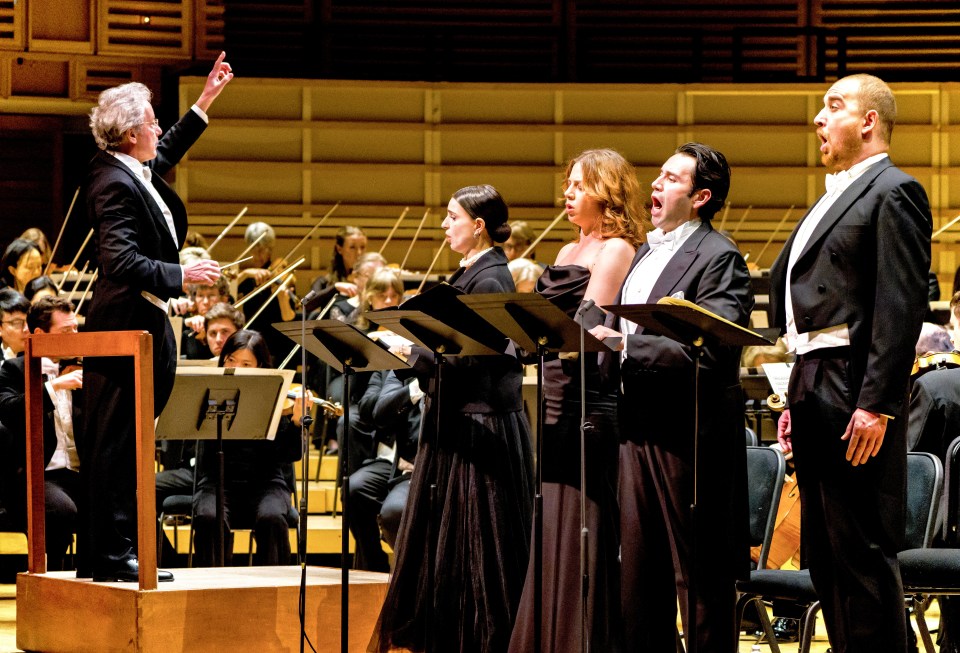
Though Franz Welser-Möst is not a natural Verdian in the lineage of Muti, Abbado, Serafin or Barbirolli, he sculpted this monolithic yet elusive score with insight—approaching it not as opera, but as what it truly is: a solemn mass meant to probe the depths of the human soul. A Requiem for the living, completed in memory of Verdi’s friend, the great poet Manzoni, and directed toward humanity’s confrontation with the transcendent—the universal God of Beethoven filtered through Schiller.
Yet even within this sacred frame, Verdi the dramatist emerges irresistibly, offering a gallery of vocal archetypes distilled into pure music, free of narrative constraints. Echoes of Eboli, Radamès, Leonora, and King Philip II surface in a quartet called to sing inwardly—as prayer rather than opera, in Riccardo Muti’s words.
Welser-Möst expertly balanced orchestral, choral, and solo forces—alongside an admirable performance by the orchestra’s chorus under Lisa Wong. Toward the end of the Offertory, the conductor suffered a hypertensive episode that threatened to halt the performance; he bravely recovered and led the work to its conclusion, though he did not return for bows and was treated by medical staff.
The solo quartet—soprano Asmik Grigorian, mezzo-soprano Deniz Uzun, tenor Joshua Guerrero, and bass Tareq Nazmi—performed superbly.
The young Turkish mezzo brought a substantial voice, at times overly forceful; Guerrero, after a decidedly too operatic Ingemisco, gathered himself for an exquisite Hostias of refined humanity. The evening’s surprise was Nazmi, whose cavernous, imposing bass recalled great voices of the past. In the Confutatis, the Kuwaiti singer thundered with both authority and spiritual gravity.
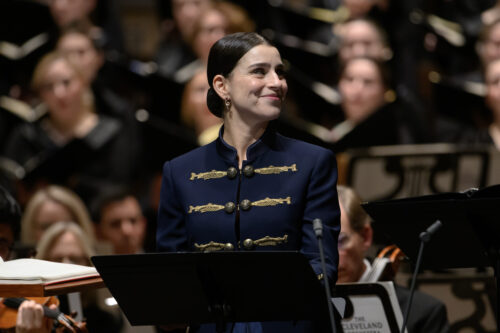
But the true event was the local debut of Asmik Grigorian, who confirmed why she is today the most sought-after soprano on the international circuit. Possessing a flexible instrument and extraordinary expressive range, she calibrates her resources with rare intelligence. Grigorian is a fearless all-rounder — a true rara avis who not only «sings», but sings with purpose and depth.
In the final Libera me — that towering scene condensing all of Verdi’s dramaturgy and mercilessly exposing every facet of the soprano voice — she triumphed with ease and assurance, floating the dreaded high B-flat in a pianissimo that sliced the air before surging into the final phrase, addressed to the audience as an intimate and defiant plea: Libera me, Domine, de morte æterna, in die illa tremenda.
If Die Fledermaus reminded audiences how hard can be to perform operetta in modern times, Verdi’s Requiem, reaffirmed the enduring capacity of canonical masterworks—realized with interpretive rigor and technical excellence—to engage modern audiences at the deepest intellectual and emotional levels.