A Luminous Tristan at the Met: A Glimpse of Hope
In a world governed by chaos, there is still room for a measure of optimism. A sold-out house —not only of seasoned operagoers, but with a significant presence of young people— attending Tristan und Isolde, a five hours opera in German is no minor detail. It is a symptom. And also a refutation. If the unfortunate recent remark by Timothée Chalamet hinted at a disconnect between younger generations and classical forms, the reality onstage suggests the opposite: there is no structural disinterest, but rather a transformation in the conditions of access, mediation, and meaning. Opera —by virtue of its duration, complexity, and demands— might seem an unlikely survivor. And yet, one need only step into the Met to realize that such a narrative is, at best, incomplete.
Decades ago, the revered Dietrich Fischer-Dieskau declared that opera was dead. It was not then, and it is not now. What it does share with all the arts is a condition of permanent crisis. But crisis, far from signaling an endpoint, is intrinsic to its existence. Art does not survive in spite of instability, but through it. In this context, every significant new production is not merely an aesthetic event: it is an act of cultural continuity.
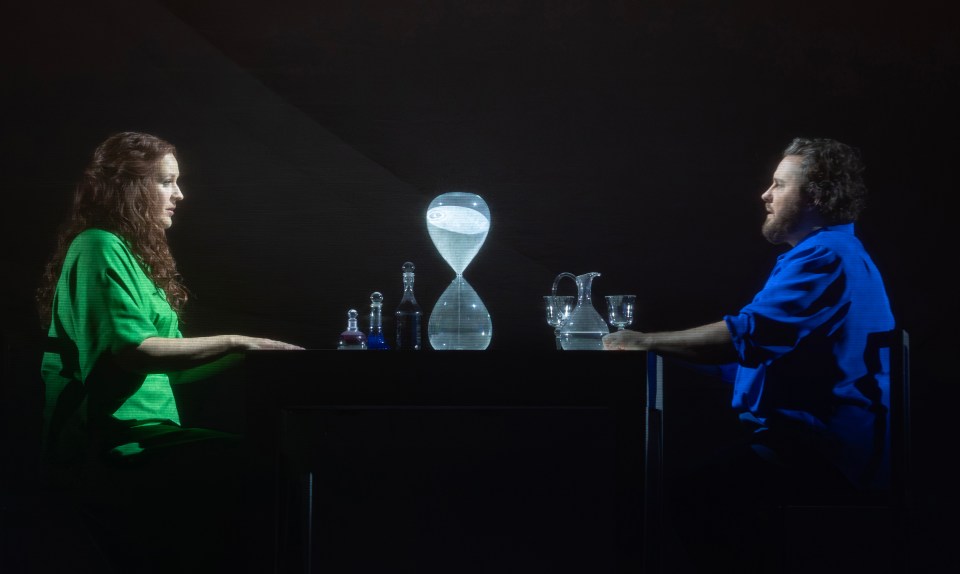
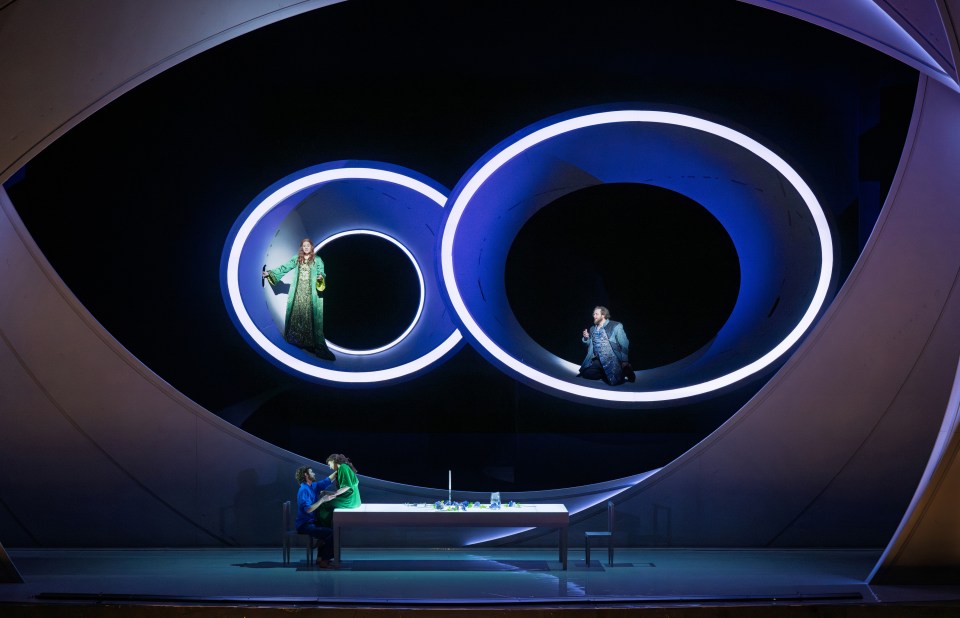
The Met’s new staging of Tristan, directed by Yuval Sharon, situates itself precisely at that intersection between tradition and contemporary reinterpretation. Where the 2016 production by Mariusz Treliński offered an immersion in darkness —a sealed universe, black upon black in a Rothko-like gesture, culminating in Isolde’s suicide— Sharon proposes a conceptual inversion: light as a structuring principle. This is not merely an aesthetic choice, but an interpretive stance toward a work that, from its very conception, is built upon the tension between day and night, between the visible and the desired.
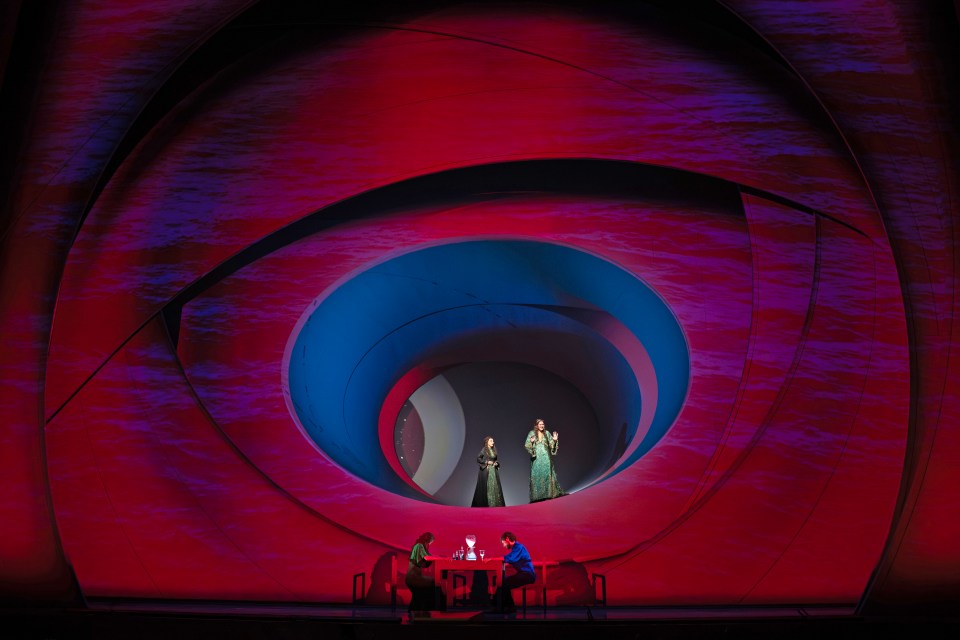
The scenic device —a kind of tunnel, a cosmic pupil, a passage suspended outside time— functions simultaneously as dramatic space and perceptual metaphor. It places the spectator in an ambiguous position: observing, yet seemingly observed. The characters inhabit this conduit as if trapped within someone else’s consciousness —or their own. The echo of the “time tunnel” in the old Ring of Götz Friedrich is no coincidence: here too, time becomes a malleable substance.
The inclusion of stage doubles —bodies that embody what others feel, externalizing mental states or inner drives— adds a further interpretive layer. While conceptually defensible, it ultimately loses effectiveness, particularly in Act III, where an accumulation of signs begins to diffuse focus. The attempt to materialize Tristan’s fevered mind is compelling in theory, but fragments in execution. And yet, Sharon takes risks where others hesitate: in the ending. Where tradition finds transfiguration, he proposes continuity. A child, the consequence of the lovers’ union, entrusted to King Marke. A persistence of life. Daylight —that force Wagner opposes to the realm of night— does not destroy, but endures. There is no redemption, but expansion; the Liebestod ceases to be transfiguration and becomes instead Isolde walking into infinity.
The projections —a continuous flow of images— construct a visually compelling universe. The sea, omnipresent, pulses as origin and destination; liquids, an insistent metaphor for love and death, recall Susan Sontag’s insight into Wagner’s material sensuality. Shadow-play and graphic-novel inflections flirt with the mythic. Yet not everything that seduces sustains: at times, the imagery underlines where it should suggest, explains where it should remain silent. In Act II, however, poetry prevails: the lovers drift in separate spheres that gradually converge, as if the cosmos itself responded to their desire. For a fleeting moment, image and music breathe as one.
If the staging oscillates between fascination and redundancy, the music —that inexhaustible subterranean current— rises as incontestable truth. It is on the musical plane that the production achieves its greatest coherence and depth.
When Richard Wagner completed Tristan, he feared he had created something unmanageable, capable of driving listeners to madness. He was not wrong. This is not music that accompanies: it absorbs. It does not describe: it transforms. It is a limit-experience —not something one listens to, but something one undergoes. When Bruno Walter told Thomas Mann that it was “no longer music,” he touched on a difficult truth: Tristan inhabits a threshold between the sensible and the unsayable.
From the pit, Yannick Nézet-Séguin does not so much conduct as breathe. His reading is distinguished by its ability to sustain continuity without sacrificing tension; he breathes with his singers —literally singing with them— shaping each phrase with elegance and deploying a vast palette of color. His approach is neither the mysticism of Wilhelm Furtwängler nor the existential anguish of Daniel Barenboim, but rather a panoramic, cantabile vision in which the so-called “endless melody” unfolds with structural naturalness. The Met orchestra responds as a living organism: the sonic tide swells, folds, dissolves, and reemerges. And in Act III, when the English horn appears onstage, time seems to stop: that suspended lament contains all the world’s nostalgia.
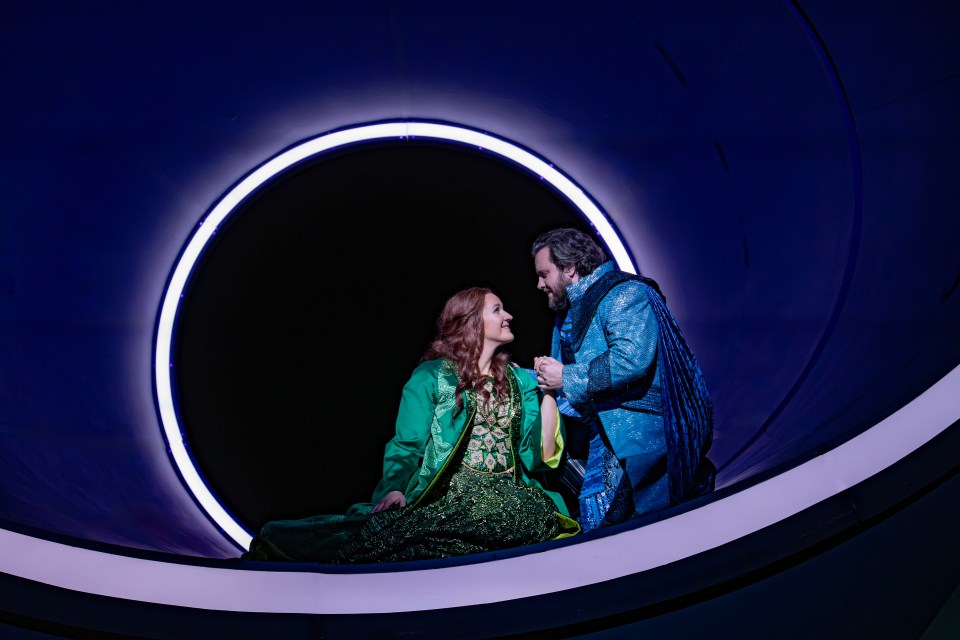
From time to time, nature reminds us of its presence. In this case, through Lise Davidsen, a vocal phenomenon devoid of artifice. She simply is, and that suffices. She captivates through naturalness and innate nobility: no exaggeration, no mannerism. Her instrument —colossal— gleams in the upper register and moves in the middle voice; if there is metal, it is bronze rather than steel. Her Isolde evolves across the evening, beginning as an impulsive, almost adolescent figure. Her presence, nearly Pre-Raphaelite —an echo of Dante Gabriel Rossetti— clad in emerald tones evoking her native Ireland, is hypnotic. In only her second assumption of the role, the path is already clear. One can only wish her the fortune of a Birgit Nilsson meeting a Wieland Wagner to fully refine her artistry. Meanwhile, the memory of her illustrious compatriot Kirsten Flagstad inevitably resonates —that incomparable ocean of serene sound. After this Isolde, a future Brünnhilde feels more anticipated than ever.
There is in Michael Spyres an “old” sound – «die alte Weise» – that fascinates. His is a singular case —an experiment that, for now, succeeds. From Nemorino to Tristan lies a vast distance. His greatest virtue is the beauty of his timbre: he sings, rather than declaims or barks, as so many have in this punishing role. Faced with its extreme demands —especially in Act III— Spyres opts for intelligence over brute force. The low register is seductive, the middle rich and baritonal; the top is not always abundant, but truth pervades every phrase.
Veteran Ekaterina Gubanova confirms her authority as Brangäne; Tomasz Konieczny offers a rugged, stentorian Kurwenal; and Ryan Speedo Green presents a Marke still evolving, imposing in presence yet searching for deeper interpretive weight.
The audience, as always, divides itself: those who compare —who remember, who measure— and those who simply surrender. Yet both groups ultimately converge in the same state: having been pierced by something that resists reduction or explanation. Something no screen, no algorithm, no instant gratification can replicate. Saturated with beauty, both emerge grateful for the miracle of music, therein lies the deepest relevance of Tristan.
Thus, as the names of Lauritz Melchior, Flagstad, Nilsson, and Jon Vickers hover like constellations in memory, perhaps those young attendees will one day say to their grandchildren —with equal parts pride and wonder—: “We heard Davidsen and Spyres.”
Postscript: Dear Chalamet, kid, there is still time. The potion is still at work. And whoever tastes it is never quite the same again. Just try it.
Photos: Karen Almond / Met Opera
