Patrick Quigley: Farewell to Seraphic Fire
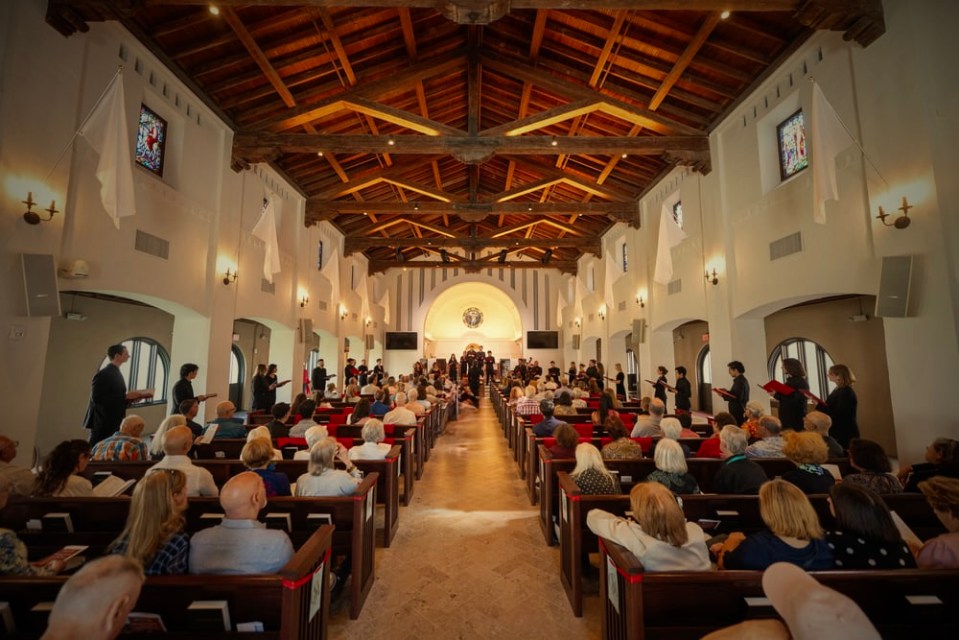
Last Sunday at Miami Beach Community Church, Patrick Dupré Quigley, the tireless visionary who shaped Seraphic Fire into one of the nation’s most luminous vocal ensembles, took his leave after more than two decades at its helm before departing to Opera Lafayette in Washington, DC. He will be back for a yearly concert, next season to conduct One for All in January 2027, a program celebrating more than one thousand years of repertoire written for men’s voices.
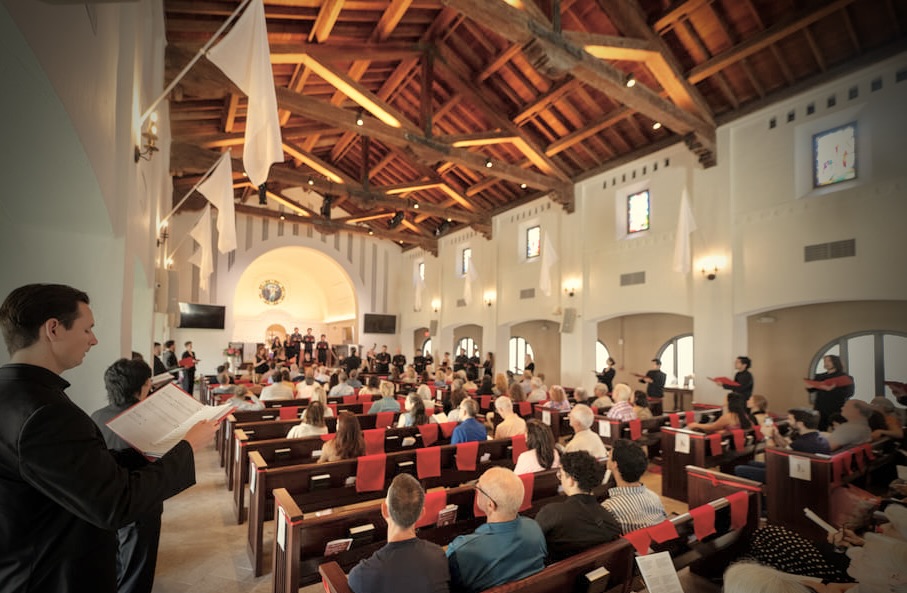
Faithful to his restless imagination, Quigley conceived a program titled “Surround Sound,” where voices did not merely project—they moved, encircled, breathed around the listener. The audience was no longer seated before the music, but within it. This was a return to an older wisdom, what emerged was both striking and intimate—a rare union of sonic grandeur and crystalline clarity, where each vocal line revealed itself like a thread of light.
Quigley himself spoke of this “music that surrounds in every sense,” evoking something otherworldly, almost disembodied. Yet his vision remained grounded in purpose: to honor both the ancient and the new, to sustain a living repertoire that stretches across centuries. With gratitude to singers, listeners, and patrons, he passed the torch to his successor, James K. Bass, and hinted at what lies ahead.

The program unfolded like a journey through time. In the Agnus Dei of Tomás Luis de Victoria, the singers formed a gentle arc along the church’s flanks. The sound seemed to bloom from stillness—expanding, softening, and returning again to quiet repose. It was music that breathed, that gathered and released, held in a delicate balance between richness and restraint.
Then came a moment suspended between worlds: Immortal Bach by Knut Nystedt, drawn from Johann Sebastian Bach’s Komm, süßer Tod. Here, familiar harmonies dissolved into a shimmering field of sound, as voices lingered, overlapped, and slowly drifted apart. The singers moved through the space like echoes and the church became a living instrument—its air charged with resonance, its silence alive. The effect was hypnotic, at once fragile and immense.
In and the swallow by Caroline Shaw, brevity held great weight. Dissonance and lyricism intertwined like opposing currents, suggesting grief and consolation.
The closing works by Claudio Monteverdi returned the listener to an earlier dawn of musical expression. In Beatus Vir, rhythmic lightness allowed voices to emerge and recede as a gentle play of presence and absence. And in Ave Maris Stella, from the 1610 Vespers, the evening founds sound rising in slow, luminous waves, gathering into a final “Amen” that seemed to hover in the air long after the last note had been sung.
The concert revealed something essential: that space itself can sing, that music is not only heard but inhabited. This was no simple farewell. It was a distillation of Quigley’s artistic spirit—imaginative, exacting, and deeply human. A parting not marked by nostalgia, but by resonance: a sound still unfolding, even as it fades.
SERAPHIC FIRE INFORMATION AND NEXT SEASON
miami clasica
- Compartir en X (Se abre en una ventana nueva) X
- Comparte en Facebook (Se abre en una ventana nueva) Facebook
- Compartir en LinkedIn (Se abre en una ventana nueva) LinkedIn
- Compartir en Reddit (Se abre en una ventana nueva) Reddit
- Compartir en Tumblr (Se abre en una ventana nueva) Tumblr
- Haz clic en Pinterest (Se abre en una ventana nueva) Pinterest
- Enviar un enlace a un amigo por correo electrónico (Se abre en una ventana nueva) Correo electrónico
- Imprimir (Se abre en una ventana nueva) Imprimir
