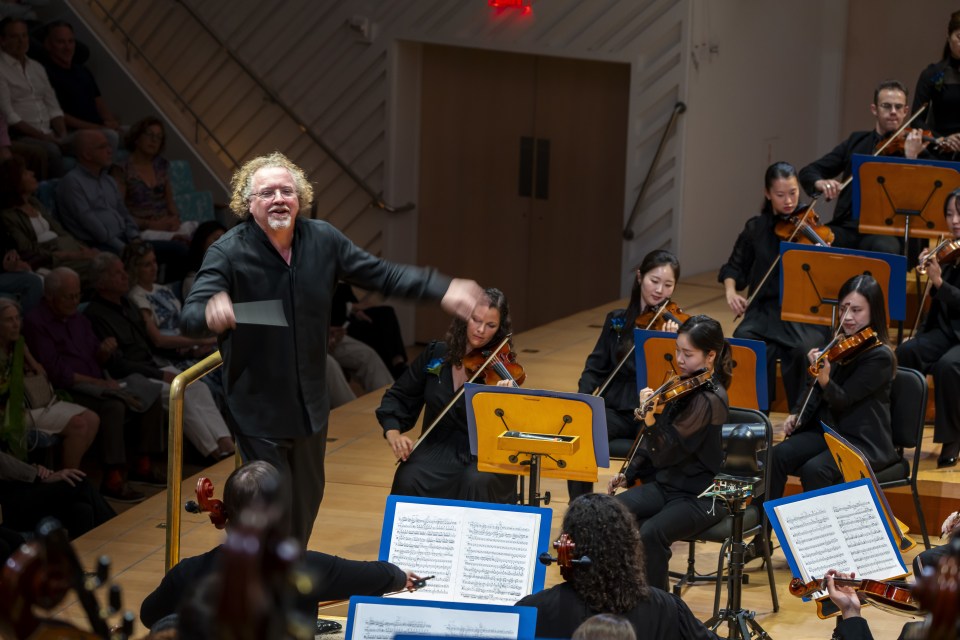
Denève & Thibaudet, Two Frenchmen in Miami Beach
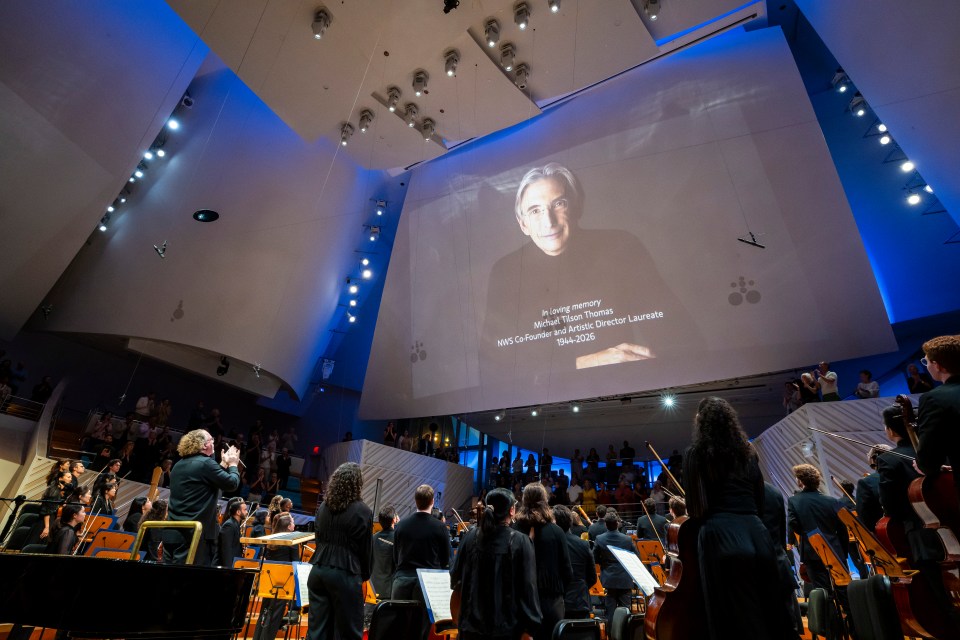
The finest interpreters of the autumnal Marschallin—from Der Rosenkavalier by Richard Strauss—often maintain that the secret to making her final farewell truly memorable lies in leaving the audience with one eye in tears and the other dry, filled with hope. Under that premise, one might draw a parallel with the concert that closed the New World Symphony’s 2025–26 season in Miami Beach: an evening as emotional as it was hopeful, where past and future converged with remarkable naturalness. It was not merely a carefully structured program, but a reaffirmation of a formative and artistic tradition deeply rooted in the vision of its founders.
On one hand, the well deserved, unavoidable tribute to its creator, Michael Tilson Thomas, who passed away two weeks earlier, as well as to its philanthropist Lin Arison, who died last October. On the other, the farewell to the fellows completing their tenure, and—last but not least—to the indefatigable Howard Herring, the organization’s executive director, who retires after 25 years of leadership as impeccable as it is—one might venture—irreplaceable.
Guided by two distinguished Frenchmen, the program brought together two composers closely aligned in every respect with Tilson Thomas, whose music he championed like few others: Leonard Bernstein and George Gershwin. In Bernstein converge Tilson Thomas’s artistic and emotional lineage—as disciple and heir—while in Gershwin one finds an elective affinity cultivated over decades. The program thus revealed itself as an emotional map, tracing the roots and passions of the recently departed maestro.
Generous and precise, Stéphane Denève opened the evening with a historical audiovisual document: the overture to Candide conducted by Tilson Thomas at the 1980 Kennedy Center Honors, before the honoree Bernstein. Agile and incisive, imbued with theatrical irony, the performance—though mediated by time—retains its communicative vitality intact.
This was followed by Nicholas Hersh’s orchestral arrangement of “Make Our Garden Grow,” which emerged as a living metaphor: like Bernstein, Tilson Thomas cultivated generations of musicians who continue to flourish today.
Bernstein’s Symphony No. 2, The Age of Anxiety, occupied the center of the program. Inspired by the eponymous eclogue by W. H. Auden, the work lies somewhere between the symphonic and the narrative. Composed at the age of 30, it reveals its multifaceted personality through the stories of four people in a Manhattan bar during wartime. It is also Bernstein’s own story, and the reflections of his mind describing the seven stages of life—alongside seven more tracing the characters’ search for meaning. An autobiographical meditation: obviously the piano embodies the composer in his quest to be heard in a strange, distant world.
Recently honored in his native country, pianist Jean-Yves Thibaudet returned as soloist, bringing the blend of technical virtuosity and expressive subtlety that has long defined his artistry. He navigated the richness of this intricate score with ease, alternating passages of rhythmic brilliance with moments of delicate introspection. His interpretation fully embodied that quintessentially Bernsteinian quality, as Thibaudet says: “it is written, not improvised, yet it sounds as though it were.” Denève, for his part, balanced structural density with fluid discourse; in “Masques” he revealed the work’s jazz-inflected pulse with precision, approached by Thibaudet with remarkable stylistic ease. The Epilogue was shaped with restrained eloquence, avoiding rhetorical excess in favor of direct, profound communication.
Denève introduced a modification to the program to include La cathédrale engloutie by Claude Debussy, in tribute to Lin Arison. In its orchestral version—drawing on the transcription by Leopold Stokowski—the piece assumed an almost architectural dimension, while Thibaudet deployed a palette of colors evoking the image of a cathedral rising from the depths, in a mesmerizing interplay of resonance and silence.
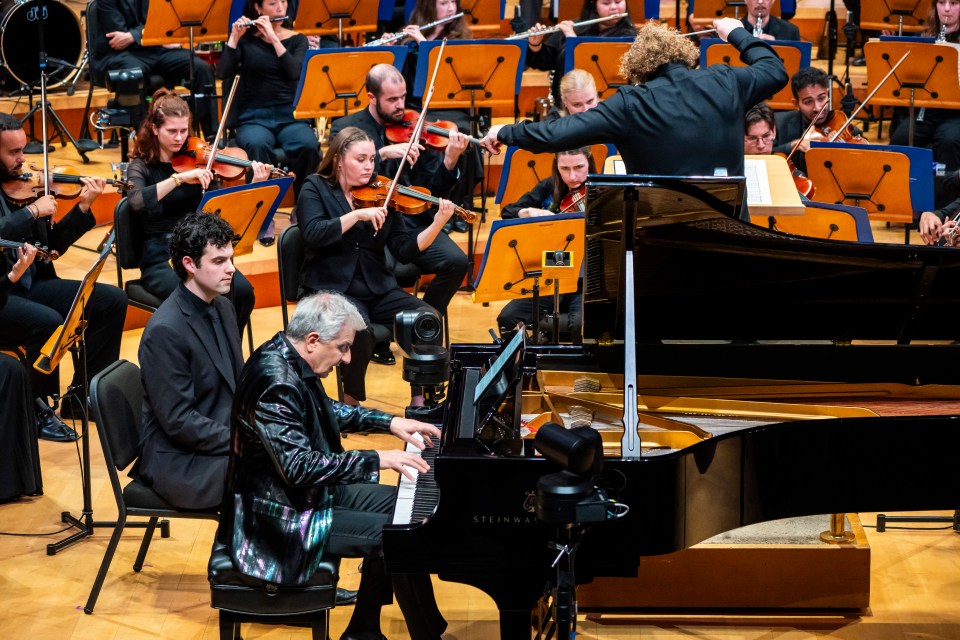
The second half opened with Variations on “I Got Rhythm” by Gershwin, in an arrangement by William Schoenfield, conducted by fellow Ziwei Ma. The reading restored the vitality of the composer’s last complete classical work, balancing formal rigor with jazz spontaneity. Thibaudet once again affirmed Gershwin’s enduring relevance through his stylistic versatility.
An American in Paris, an emblematic work of the American repertoire, was conducted by Denève with deep understanding of its contrasts: the stylized elegance of French tradition and the expansive vitality of the American urban imagination. This time, the perspective was reversed—a Frenchman in America, honoring his adopted world. The instrumental solos—particularly the trumpet in the blues section—offered moments of striking expressivity, while the cohesion of the ensemble allowed for a reading of sovereign brilliance. The visual accompaniment, a collage of images, enriched the experience without unduly distracting from the musical substance.
The encore, the overture to Girl Crazy, returned to Gershwin at his most theatrical—the composer who launched the careers of Ethel Merman and Ginger Rogers. Under Denève’s direction, the music flowed with naturalness and elegance, capturing the lighthearted—yet sophisticated—spirit of songs such as “Embraceable You” and “But Not for Me.”
Denève thus sealed an evening that inscribes itself both in artistic memory and in the institutional history of the New World Symphony. More than a retrospective tribute, the concert emerged as an affirmation of continuity: the certainty that the legacy of Michael Tilson Thomas does not end with his passing, but endures in the living practice of those who, shaped under his influence, continue to make music a space for transmission, renewal, and meaning.