Beyond Tradition: The New World Symphony Between Exaltation and Experiment
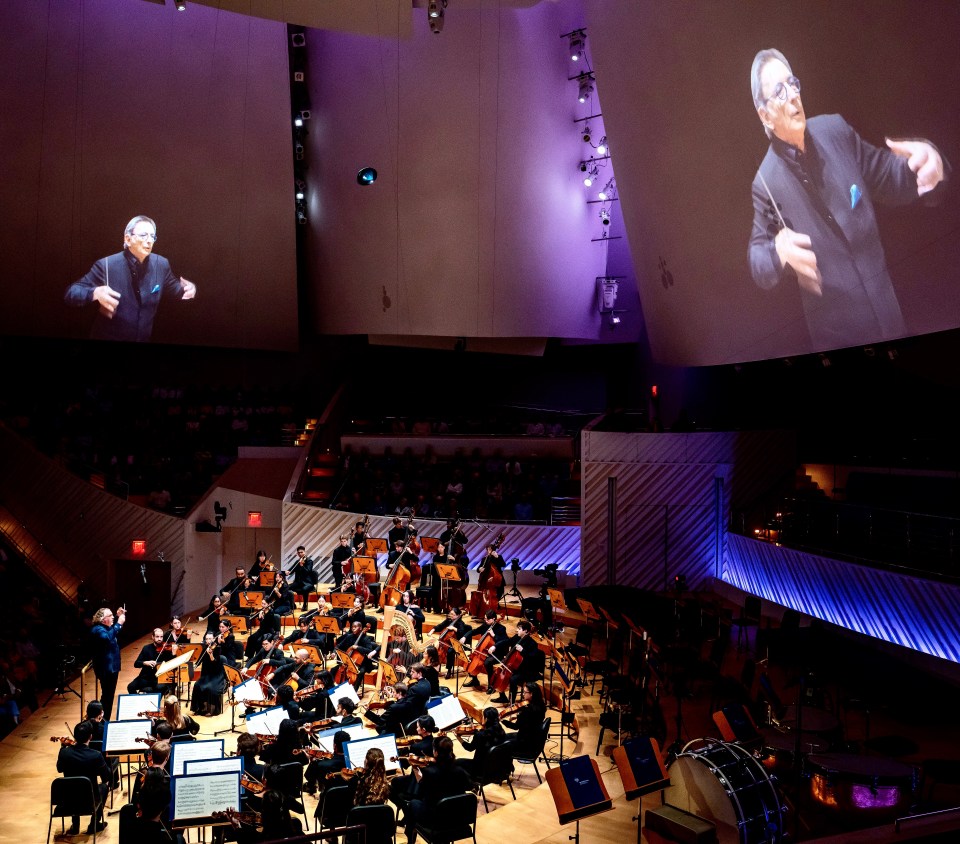
The two opening concerts of the New World Symphony’s official season were marked by a degree of exaltation that, at times, edged out emotion. This emphasis on experimentation reaffirmed the American Orchestral Academy’s character as a musical laboratory. Despite a few brass discrepancies, just beginning the season with Beethoven’s Choral Symphony in the New World Center was certainly a major challenge, all the more so with thirty new fellows joining the ensemble, whose full integration will take place over the course of the season.
The first concert opened with a celebration of Hispanic Heritage Month. Under the vigorous baton of Ziwei Ma, Gabriela Ortiz’s effervescent Kauyumari gave way to Arturo Márquez’s rhythmically charged Fandango for Violin and Orchestra, commissioned and premiered by Anne Akiko Meyers in 2021. Although somewhat overextended, the work allowed the distinguished soloist to display her fundamentally powerful tone in a score designed to showcase her interpretive strengths.
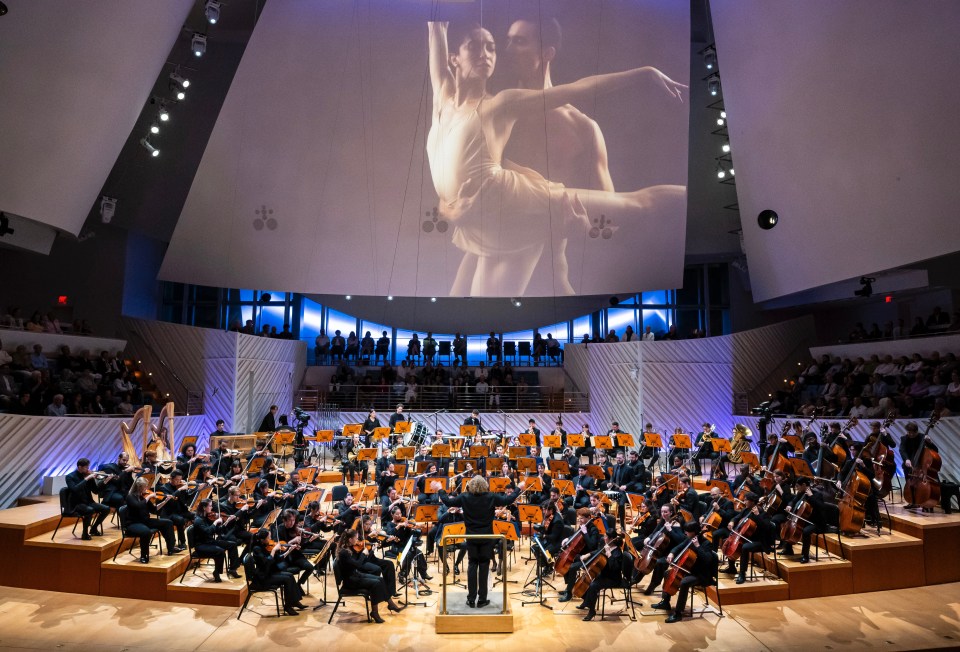
The second half, devoted to the French repertoire so dear to artistic director Stéphane Denève, found Claude Debussy’s Ibéria an ideal vehicle for his refinement of orchestral color and his exquisite attention to detail. Ravel’s popular Bolérobrought the evening to a fervent close, with an orchestra responding enthusiastically to the conductor’s infectious energy.
As a welcome bonus, a choreography by Nathalia Arja, projected on the screens, returned Boléro to its origins as a dance created for Ida Rubinstein in 1928. Macarena Giménez and Stanislav Olshanskyi, both distinguished dancers with Miami City Ballet, delivered performances of a high standard, somewhat undermined by unnecessary close-ups that prevented viewers from appreciating them in full. By privileging sensuality over choreography, the beautiful audiovisual production ultimately overshadowed what it was meant to enhance.
The second program, conceived as a tribute to Michael Tilson Thomas, founder and music director of the New World Symphony, who died on April 22, offered a journey from the present into the past.
The evening began with Notturno for flute, harp, and strings, a little gem composed by Tilson Thomas in 2005 for his sister-in-law, flutist Paula Robison, and dedicated to Paul Renzi, who served as flutist with the San Francisco Symphony for half a century. Beginning with an almost Zen-like melody of Eastern character, the score gradually moves toward an Italian evocation of unmistakably operatic spirit. Demarre McGill, principal flute of the Seattle Symphony, delivered a superb performance, supported by the strings in a persuasive vindication of this beautiful chamber work.
The tribute gained emotional intensity with the Adagietto from Mahler’s Fifth Symphony, a composer central to Tilson Thomas’s artistic journey. As footage of his own performance with the New World Symphony was projected, Denève led the musicians live, following his predecessor’s tempi and interpretive conception. From the most delicate pianissimos to the sonorous climaxes, memory became music in tribute to the institution’s founder.
If Mahler represented an emotional continuity with Tilson Thomas’s artistic universe, Beethoven’s Ninth Symphony not only anticipated the 2027 bicentenary of the composer’s death but also introduced a different perspective: that of interpretive experimentation. Denève recalled that Tilson Thomas had recorded the Ninth twice and returned to it repeatedly throughout his career.
Drawing on conductor and musicologist Jonathan Del Mar’s 1996 edition, Denève chose to honor Beethoven’s original metronome markings, whose tempi differ radically from those commonly heard today. This decision reopened a longstanding controversy: Were Beethoven’s early metronomes accurate? Could his advanced deafness have affected his perception of instrumental balance and orchestral blend? There are, in fact, no definitive answers or universally accepted interpretations.
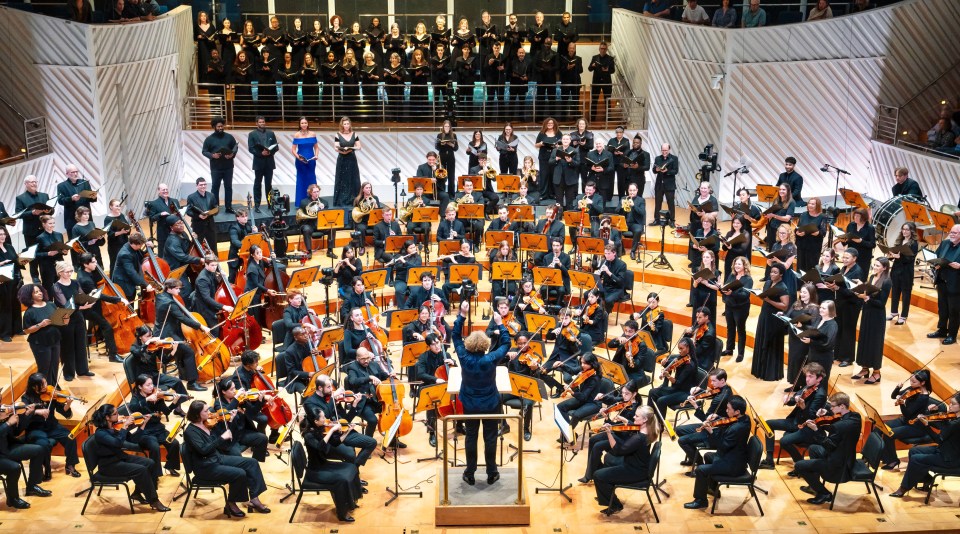
The stage arrangement reinforced the sense of immediacy, with the violins positioned on either side of the conductor, the double basses to the left, and the percussion on elevated platforms to the right. The final movement, with its apotheosis of collective expression, added a theatrical dimension to the work. The sonorous, velvety sound of the cellos and double basses announced Friedrich Schiller’s celebrated “Ode to Joy,” as the soloists and the dependable Master Chorale of South Florida gradually took their places along the sides and at the rear of the stage.
Dashon Burton brought an imposing sonority to his part, despite some blurred diction. Ellie Dehn, Tamara Mumford, and the radiant tenor Sean Panikkar completed a worthy quartet. During the Turkish march, a moment of surprise and curiosity came when the percussionists paraded along the front row of the auditorium. The chorus, prepared by the indefatigable Brett Karlin, delivered its customary effectiveness, sustaining a headlong finale in which chorus, soloists, and orchestra competed for momentum, while the sopranos seemed somewhat overtaxed by an unforgivingly demanding tessitura.
The performance left one question unresolved. Beethoven’s Ninth is increasingly performed at accelerated tempi in an effort to recover the original impetus of a work that the Romantic tradition transformed into a monument, one Wagner famously described as “the human gospel of the art of the future.” The aim is to rediscover the revolutionary Beethoven: impetuous, capable of breaking through formal boundaries and hurtling toward the future.
A Ninth that is excessively solemn may lose its fire, but one that moves too quickly risks losing its soul, leaving behind the very greatness that lies in making us feel how arduous the journey toward human fraternity has been. In a musical laboratory such as the New World Symphony, positioning itself as a leader in shaping that future, experimentation is not merely an end in itself, but an ongoing search for fresh perspectives on familiar masterpieces as this one for which a definitive resolution remains elusive.
photos Alex Markow, courtesy of NWS
