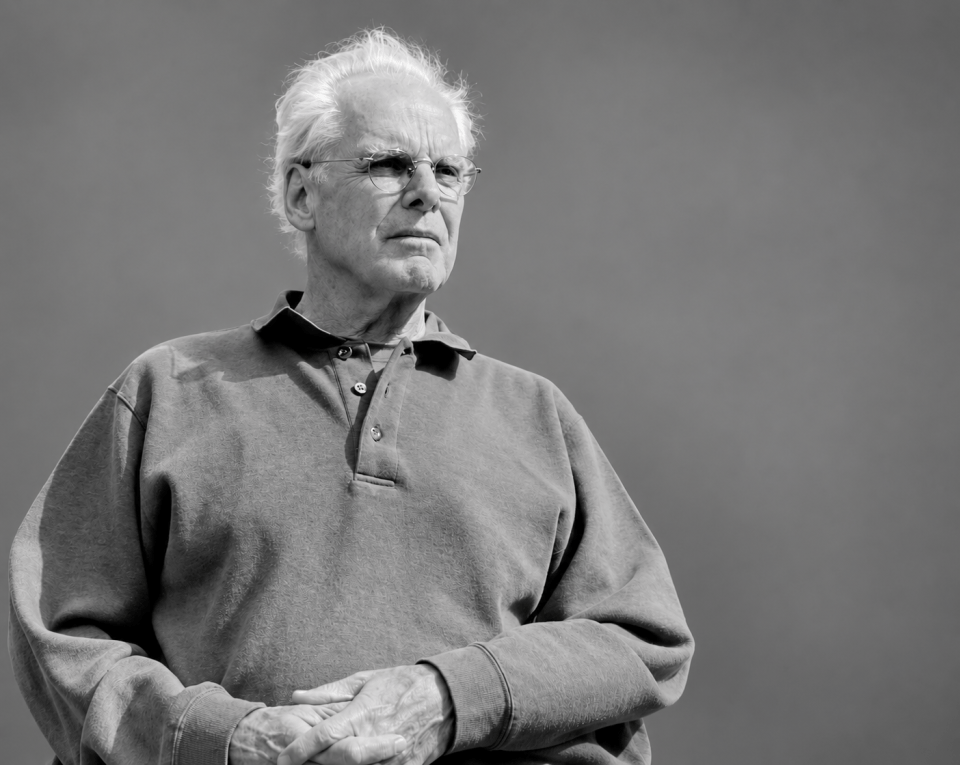
Howard Herring, a Maverick Bows Out After 25 Years
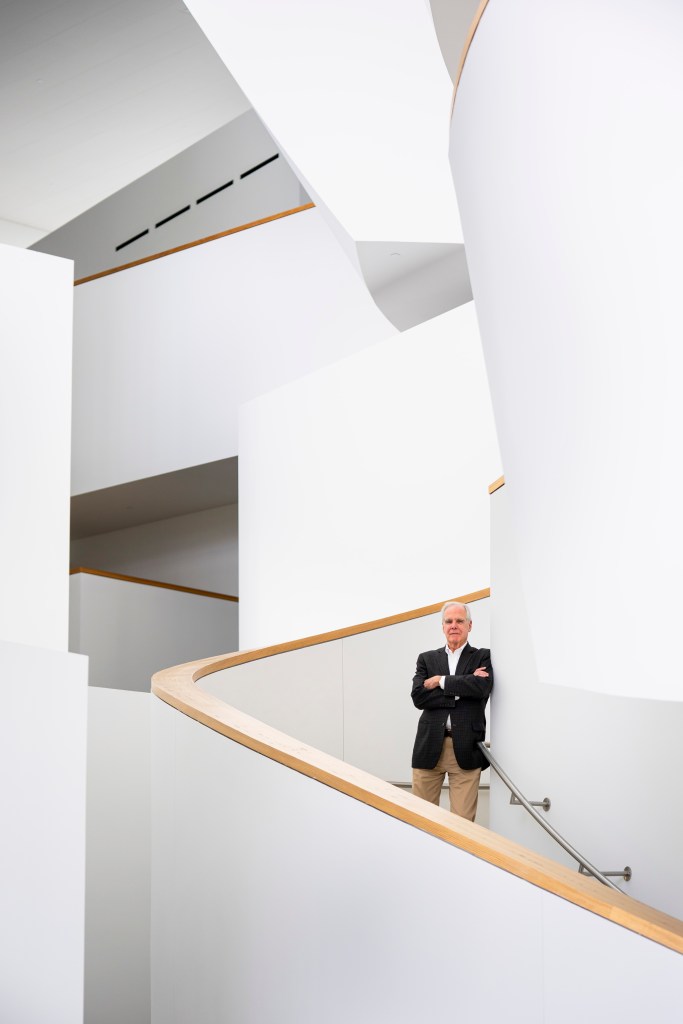
Herring at the New World Theatre – photo Alex Marlow
Never was the saying “Where he points his eye, he hits the target” more fitting than when Michael Tilson Thomas chose Howard Herring as CEO of the New World Symphony. Although Herring came to Miami from the urban Northeast 25 years ago, he never stopped being the genuine maverick from his native Oklahoma.
Half musician, half executive, he was the ideal co-pilot for MTT and his extraordinary project. Today, after a quarter of a century at the helm of the institution, his retirement makes it difficult to imagine the New World Symphony without his indomitable energy and optimism. A visionary in the truest sense and an eternal conciliator, even as a General he always remains a Soldier of Music, for whom “Always ready” is not merely a motto but a trademark.
You have led the New World Symphony for 25 years. Looking back, what was your original vision for the institution, and how has that vision evolved?
When I came to interview, the New World Symphony was only 13 years old. It was already a very young institution, but it had a reputation. If you talked to young artists who had been in the program, you understood that they gained something at New World that they would never have gained in an academic setting, in a music school or conservatory, here they gained breadth and depth. They began to understand what it meant to pursue a career in music, to be a professional, to be an artist.
I remember quite vividly the second interview. I spent the afternoon with Michael. We talked broadly and specifically. At the end, as I was walking out, I shook his hand and said, “If you would like me to come join you in this endeavor, I’m ready. You just tell me.” And I was the lucky person who got the position.
If you could return to your first day as CEO, what advice would you give yourself?
When you come into a new position, it’s always a little nerve-wracking. I felt like I was in a new world. Because we are so structured, and because music and education and professional life are so structured, if I had been a better listener and more aware of just how different the environment was and would continue to be—I use the word unique, and I don’t think that’s a misuse of the word—I would have understood it better.
It was very different for you coming from the musical world?
Absolutely. I had been a pianist, and then I had run the Caramoor Music Festival for 15 years. Professional music has well-defined structures: how you plan a season, book artists, imagine audiences, communicate with those audiences, and spend time with people who write about music. But there’s not the blank slate that is New World. It’s like a white canvas. It took me a while to absorb that, to internalize it.
I can remember friends up north saying, “How in the world are you doing this? It’s Miami.” Miami had this reputation, certainly in the Northeast and New York area. And I remember thinking that when I was out in the street, I was in Miami. But as soon as I walked in the stage door of the old Lincoln Theatre, I was part of Western art music. It could have been Leipzig, Beethoven’s Vienna, or Debussy’s Paris. There were two distinct worlds: the inside of that building, and Miami.
What were the greatest challenges you faced when you first took the helm?
The biggest challenge was that everyone understood that Michael not only created the dream, but made it clear that the little old Lincoln Theatre, proud as it was, was okay as a starter. The institution had to have a facility that would encourage and support the mission. We had to understand where we were going. Then we began to ask a very specific question: What would the fellows need in the year 2030? Looking out 30 years, what would a fellow need to prepare for a robust career, serve the art form, engage the audience, understand community, and be a digital native?
In 2006, when we engaged Gehry, we gave him this program. It was defined in two ways: vertically and horizontally. Vertically, it was what we did over 35 weeks, day by day. Horizontally, it was how many orchestras, how much chamber music, how many solo recitals, community events, and new-audience events. It took 20 minutes from “Let’s go find an architect” to the point that we were on the phone with MTT’s friend: Frank Gehry.
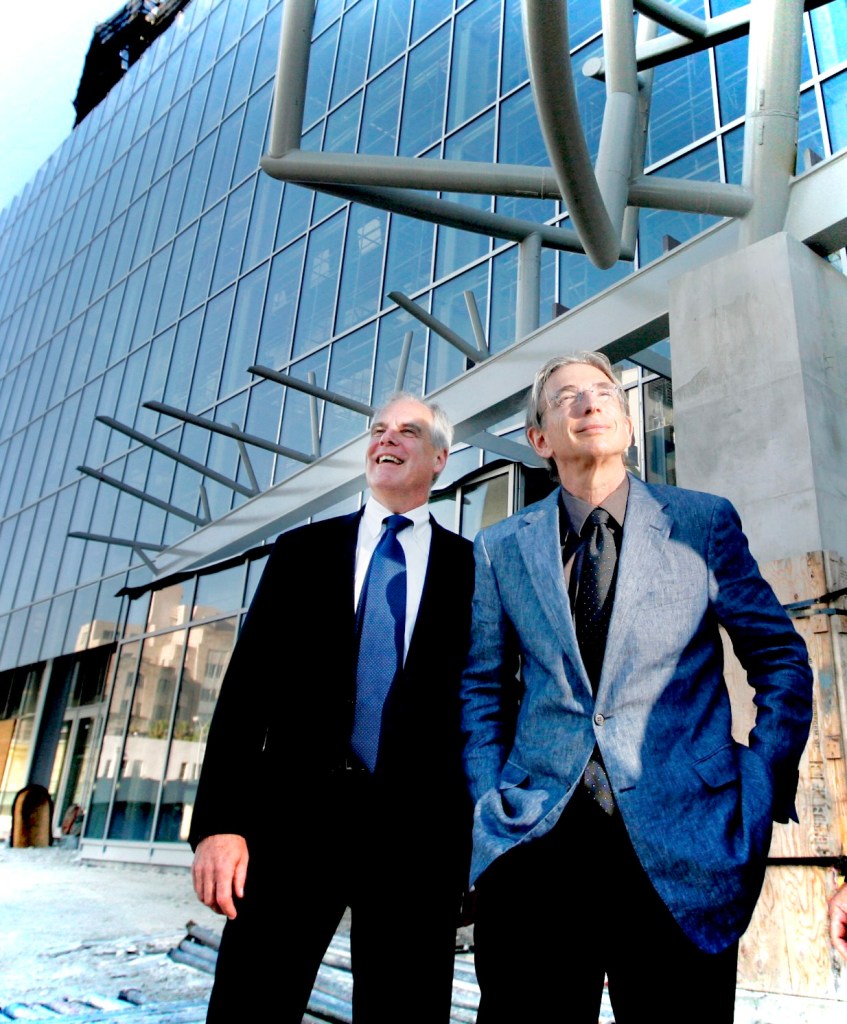
Howard Herring and Michael Tilson Thomas
What elements of Michael’s legacy must remain essential to the New World Symphony’s future?
First of all, a deep and intense commitment to the art form and the literature, and how this music speaks to its audiences. The second is that the organization must be true to his curiosity. Michael was relentless. The ideas that came from him, and the fact that he could work those ideas out at New World—often ideas that would have been impractical in a professional setting—were fundamental. He had an idea of an orchestra as something way different than playing Beethoven’s Fifth Symphony on a stage.
He came from a theatrical family. He thought that orchestra and theater belonged together. He had learned about electronic distribution in his twenties, when Bernstein gave the New York Philharmonic Young People’s Concert broadcasts. So digital made perfect sense to him.
In my first year, we got a linked grant from the National Endowment for the Arts and the National Science Foundation. They gave us $100,000 each and said, “Go buy cameras, go buy projectors, and let’s see what you come up with.” We started projecting images onto the back wall of the old Lincoln Theatre. We had interviews with composers who couldn’t be with us. We were off and running in the digital world.
So whoever comes next—in this case Stéphane, who is doing quite a beautiful job of being theatrical—Kaiser of Atlantis, La Mer—that is an essential part of the New World Symphony experience for the fellows. That’s what Michael taught us: pursue the music, share it with as many people as possible, and make it as visual and theatrical as you can, so that it’s even more vivid and memorable.
Do you think that we have lost the art of listening? Do you think classical music can restore our capacity to listen better, more deeply?
Yes, if people will let themselves. Rose Horowitch makes the case that we are now in a post-literate world. There was a pre-literate moment, and then Gutenberg pulled the press down on that piece of paper, and the world changed. We became a literate culture. And now, thanks first to television and then the internet, it’s images and voice rather than the act of reading.
To read, you must be independent. You must be absorbed in the language itself, and you are making it up as you go. You are an essential part of the creative process. Film and television tell you what to do. You have less space in your imagination to engage and create.
I don’t know where we go next, but I think there is territory to be explored in what happens when serious music and visuals are intelligently and aesthetically linked.
After 25 years, what have young musicians taught you?
All of the things I’ve learned from the fellows. I have interviewed every one. There are thousands of alumni, and as each one enters the program, I sit with them and ask, “How did this start? When did you decide that you had to be a musician, an artist?”
The vast majority will tell you that sometime between the ages of 11, 12 and 14 or 15, they have an epiphany. It usually happens in the summer, when they go to a music camp. Suddenly, they’re not just in their school ensemble or citywide ensemble. The fact that musicians make that choice at that age, and then spend their lives pursuing it, is remarkable to me.
Many can tell you the exact passage of a particular piece of music when it happened. They can tell you where they were sitting, the temperature of the air, even the fragrance if it was an outdoor venue. So they’ve taught me how powerful the music is. I knew it myself, but you hear that repeated.
Do you think it’s a problem for New World if they choose as a CEO somebody who is not an artist?
I can’t predict that, but this is myopic. It’s just the way I did it. I would say that it is extremely important that the leader have that full-on performance experience that happens as a result of the epiphany you have in your teenage years. I think it’s critical. I’ve said that about orchestra presidents. I’ve said that about heads of music schools. I don’t know how else you would do it.
Is there a particular fellow or moment that captures the essence of the New World Symphony?
Francisco Jaubert Bernard. He is a bassoon player. He’s in the Louisville Orchestra now. He grew up in Puerto Rico. His father and grandfather were both trumpet players in the Latin bands of Puerto Rico. He comes along and says, “I want to play the bassoon.” And they say, “That’s crazy. You have to play the trumpet.”
Francisco finds a PVC pipe along the street. He goes on YouTube, discovers the dimensions of a bassoon and where the tone holes are located. He cuts the pipe to the right length, draws the tone holes, and begins to practice the bassoon. Big thinker.
He comes to New World, and we encourage the fellows every year to do independent projects. Francisco decides to do a history of the music of Puerto Rico. He uses about 15 other fellows, his compatriots, and they do this over the course of a concert. Then he has the fellows join him in contemporary Puerto Rican salsa.
There were three women in the front row. When they cut into this dance music, the three of them stood up and danced. And I thought, “Yeah, okay, this is it.”
The reason I mention it is because we encourage these guys to be independent thinkers. Michael believed in this. I believe in this. Everybody at New World believes in this. Give them experiences that will make them great musicians, great artists.
Should the goal be to make audiences larger, or to deepen the relationship with the audience that already exists?
Both, emphatically both. When we came to the opening of the new building, we had a mission statement: “We believe in a strong and secure future for classical music. And we will reaffirm, reimagine, express, and share its traditions with as many people as possible.”
“With as many people as possible.”
Exactly. Go straight from that idea to Wallcast. There are ways to share this music at the highest levels of sight and sound and gain new audiences. Seventy-five percent of the people in the park have never purchased a ticket to the New World Symphony. It is a second audience. You get 750 people inside, and 2,000 outside.
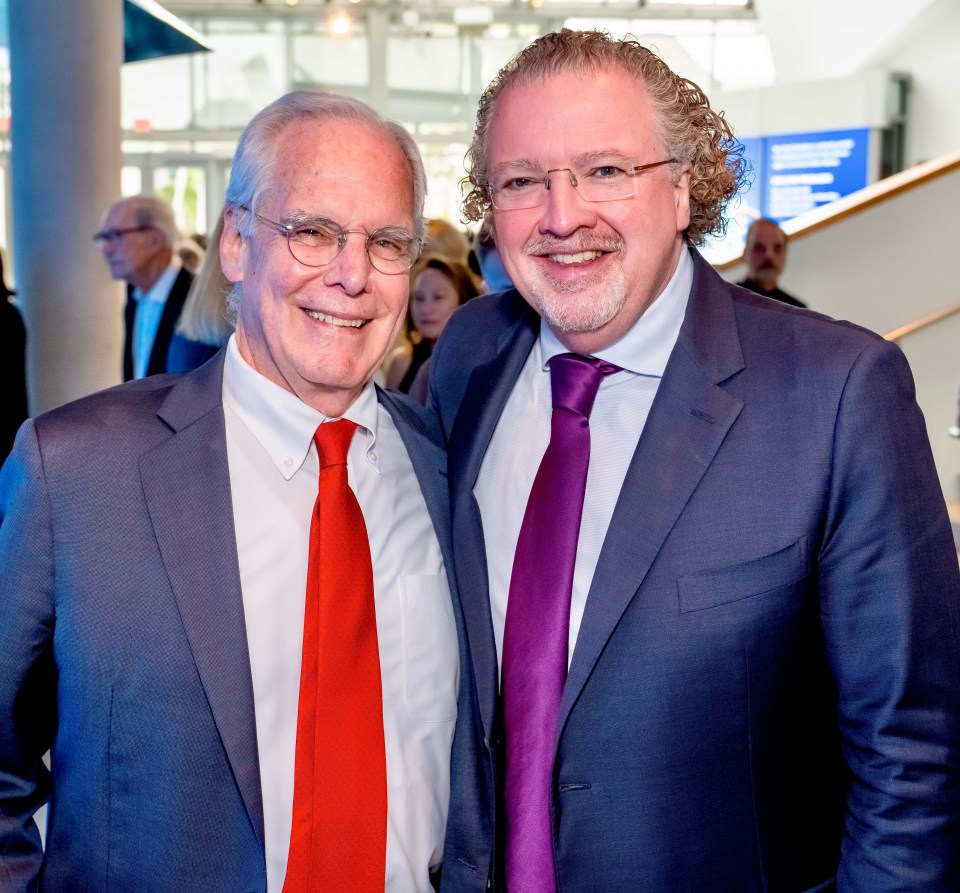
Howard Herring and Stéphane Denève
Will America have orchestras in 2076?
There will be audiences in 2076. How we make those orchestras and audiences as robust as possible has a lot to do with how independent-thinking musicians discover new ways to engage, and how society makes sure we have these communal spaces.
Those communal spaces will change in form and function. It won’t be the 2,000-seat symphony hall. It will be something that accommodates visual as well as sound. We have had orchestras for a very long time. Each time they have moved from one era to another, they have discovered what is essential in the presentation and the music itself, and then found a way to share it broadly.
How do you see Miami’s cultural landscape having changed?
In 2001, I arrive. Miami is Miami. It felt like a great big little town. Then in 2002, Art Basel stages its first fair, and year by year the ancillary fairs begin to emerge. Between 2006 and 2016, public-private partnerships built $1.3 billion of cultural infrastructure: New World Center, the Arsht Center, Pérez Art Museum Miami, Frost Science, the Moss Center in South Dade, and ICA.
Miami changed. It became a city with infrastructure that would support and encourage sophisticated artistic expression.
As those buildings were coming to fruition, a whole new group of significant institutions began to grow. One of them is Miami New Drama. O, Miami Poetry Festival is all over the city and engaging at every level, and Miami Music Project has about 500 students receiving high-level training.
My point is that yes, the buildings are important, but the programs are even more important.
There’s a wonderful quote from Mike Bloomberg: “Culture attracts capital, far more often than capital attracts culture.” It’s perfect for this city. There was a limited cultural presence in Miami in 2001. And now we have what we have. How do we keep it? That’s the problem.
Which challenge tested you the most in these 25 years?
Without a doubt, COVID. Because we couldn’t be together. One of the most important parts of music is the individual transformation in a communal setting. This happens at a concert. Individuals are in touch with themselves, and the music is carrying them. It’s a communal experience, amplified by the fact that we’re all together. And all of a sudden, we couldn’t be together. Eight days after we closed the theater, we gave our first online concert. We continued giving online concerts weekly for the rest of COVID. But it’s not the same.
Why is this the right moment for you to step down?
Twenty-five years is quite a time. And it is time for someone younger to come to the institution and bring their dreams, spirit, and intellect and guide it for the next period of time.
It’s partially the fact that I realized I was making plans for projects that I might not carry out. And I thought, you know, that’s not fair to the institution. So it was not easy to decide, but I did decide it was best for me and best for New World.
And what are you going to do?
I have always loved to write. I want to start fresh with Miami, partly because it’s a big story, but also because I want to write about it. I have started an organized essay about Miami, and the point of entry will be serious music, serious art, serious cultural activity, which has changed the city.
I’m going to write about music. (*) I’m going to write about Miami.
So you are the gringo who became Latino, almost.
That’s right. Almost.
After a quarter century, what will you miss most, and what do you hope they will inherit from your leadership?
What I will miss most is knowing the fellows. They are talented, aspirational, intelligent, and vulnerable because they’re at the very front end of a career. They are energetic and strong players, but even more intrigued by bringing that strength to the incredible musical unit that is an orchestra.
Then you get to know them one by one—their specific aspirations, their specific dreams. That’s what I will miss. When a fellow wins a job, there is a satisfaction that is hard to describe. It sort of spreads across you physically. I will miss that very much.
And what do you hope they will inherit from your leadership?
Optimism. Curiosity. Independent thinking. Critical thinking. And always be ready to ask the question: What if?
They need to be ready to ask that question.
What if? That’s a very New World question.
…
(*) Article THE FUTURE OF THE ART FORM – SYMPHONY